Check out the educational materials that explain the working principle of the thermal camera. Answer the question.
A thermal camera is actually a device with a rather complicated working principle, which is why the question raised in the interest-generating question "Can a thermal camera see through walls?" is difficult to answer if you want to do it thoroughly. First, we should ask what a thermal camera "sees" in general.
Another option is to state that the thermal camera measures the temperature of bodies by recording the thermal radiation emitted by these bodies. In reality, such an explanation is not very good - it is also explained in the study material referred to below. However, we can already answer: "No, the thermal camera measures the temperature of the wall over the entire field of view of the thermal camera."
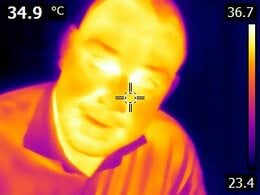
However, this is not how we can explain the image shown in the teaser, on which someone's warm face is visible in the thermal camera. The idea that thermal radiation is absorbed in some environments and not in others should also be taken into account. Heat radiation from the face passes through a plastic bag, but not through glass.
We have already encountered similar ideas, because the greenhouse effect, in which infrared light is absorbed in the atmosphere and visible light is not, was learned in the seventh grade.
The following educational material is worth reading in any case.
How do infrared thermometers and thermal imaging cameras work?
A wooden wall - or any wall at all - absorbs heat radiation emitted by bodies. When the body is against the wall, it starts to heat the wall. If the heating lasts long enough, the heat also reaches the other side of the house wall through thermal conduction. A warm spot will appear there, which the thermal camera will undoubtedly see.
If the warm body is very large, for example a cross of several meters in size, the thermal camera will probably also see the approximate shape of such a heat source. But then it is no longer the heat radiation of the body, but instead of the wall. Such warm spots can also be detected simply by measuring the temperature of the wall.
So no, you can't see through walls with a thermal camera.