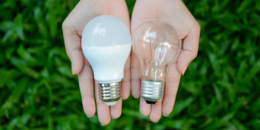
Incandescent or LED?
Let's first recall what we have dealt with in the previous lessons.
Review: Circuits, measuring voltage and current
The aim of this lesson is to get acquainted with the concepts of resistance and power of an electrical consumer.
It is not possible to "teach clearly" these concepts in a class structured like this. The idea is rather that we use again the skill learned in the previous lessons to measure the voltage and current in the circuit with a tester and do simple calculations with the results, which give understandable and expected results - we learn that the LED lamp is indeed more economical than the incandescent lamp.
We will get acquainted with Ohm's law later. Here we give simplified definitions in a simplified manner.
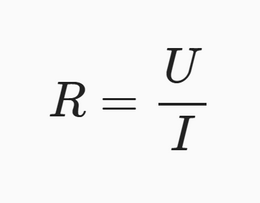
Resistance
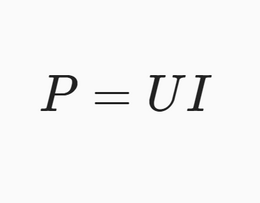
Power
First, a classic test directly using Ohm's law, where the resistance of the light bulb is determined.
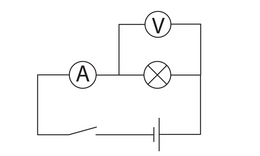
Determination of electrical resistance and power of an incandescent lamp
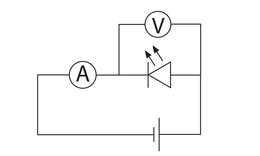
Determining the electrical resistance and power of an LED lamp
Lõpuks võrdleme mõõtmistulemusi ja teeme oma järeldused.
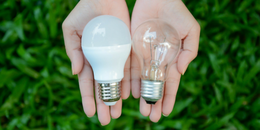
Let's compare the resistances and powers of an incandescent lamp and an LED lamp
Selle tunni lõpetuseks võiks teha ühe harjutuse, mis tuletab meelde varemõpitut ning kasutab ära andmeid, mis me eelmistes töölehtedes oleme mõõtnud.
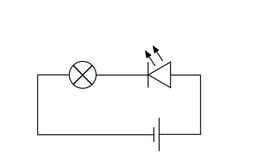
Series connection of an incandescent lamp and an LED lamp
Incandescent lamp and electric motor in one circuit
Electrical resistance
A conductor (electrical appliance) is characterized by electrical resistance. The conductor prevents the directed movement of charged particles and thereby affects the current strength.
The resistance can be calculated from the formula
new is the voltage across the conductor and is the current in the conductor. The resistance symbol is . The unit of resistance is ohm ().